Decoding Sleep Solutions: Sleep Hygiene vs CBTI. What’s Actually the Difference?

If you ever Googled “how to sleep better” at 2am, you’ve probably landed on advice about sleep hygiene. No screens before bed. Keep your room cool. Stick to a schedule. And while that advice isn’t wrong, it doesn’t always work.
That’s where the confusion usually starts. A lot of people assume that Cognitive Behavioral Therapy for Insomnia (CBTI) is just sleep hygiene with a fancier name. But it’s not. These are genuinely different approaches and understanding the distinction could completely change how you think about your sleep.
So grab your sleepy-time tea and let’s break it down.
First, What is Sleep Hygiene?
Sleep hygiene refers to the habits and environmental factors that support (or sabotage) your ability to sleep. Think of it as setting the stage:
Keeping a consistent wake time
Limiting caffeine after noon
Dimming lights in the evening
Removing screens from the bedroom
Keeping the room cool and dark
These are solid, evidence-based recommendations. But here’s the thing. Sleep hygiene works best as a preventative measure or for mild sleep difficulties. For people dealing with true insomnia (the kind where your brain just won’t let you sleep no matter what the environment looks like), sleep hygiene alone typically isn’t enough.
So, What is CBTI, Really?
CBTI (cognitive behavioral therapy for insomnia) is a structured therapeutic approach that goes after the root causes of sleeplessness. It’s not just about what you do before bed. It’s about what’s happening in your mind and nervous system that keeps sleep from coming.
CBTI includes sleep hygiene as a starting point, but it goes further with:
Sleep restriction therapy - temporarily compressing sleep to rebuild sleep drive (yes, it sounds counterintuitive, and yes it works)
Stimulus control - retraining your brain to associate the bed with sleep instead of anxiety or wakefulness
Sleep education - understanding how sleep actually works so you stop catastrophizing about it
Cognitive resctucturing - identifying and challenging the thoughts that are keeping you up at 3am
Relaxation training - nervous system regulation techniques to help your body actually shift into rest mode
According to the American Academy of Sleep Medicine, CBTI is shown to be the most effective long-term treatment for chronic insomnia, often better than sleep medication and without the dependency concerns.
The Real Difference: External vs Internal
Here’s a useful way to think about it:
Sleep hygiene works on your environment and behaviors
CBTI works on your thoughts, nervous system and deeply ingrained patterns
If sleep hygiene is a band-aid, CBTI is the work that actually heals the wound. That’s not to say that sleep hygiene doesn’t matter, because it absolutely does and it is apart of the CBTI plan. But if you’ve been doing all the “right” things and still can’t sleep, that’s a sign something deeper is going on.
Which One is Right for You?
Not sure where to start? The decision tree below can help you figure out whether sleep hygiene adjustments or a full CBTI approach might be better fit for your specific situation.
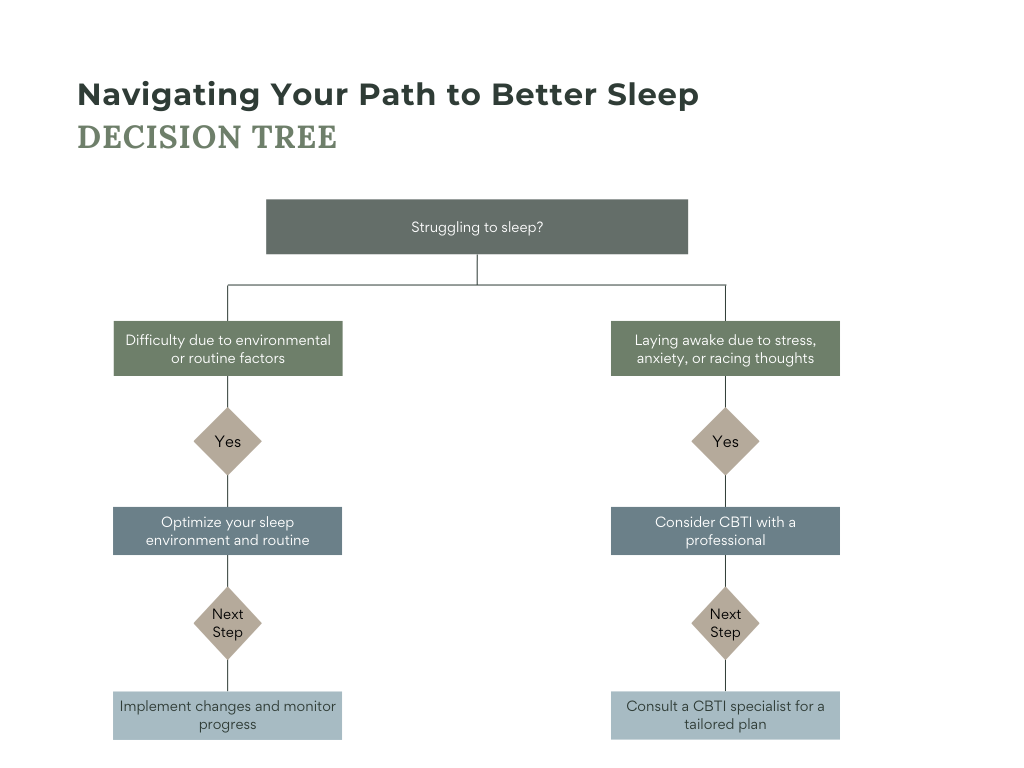
Keeping in mind, there’s no wrong answer. Some people benefit from starting with sleep hygiene changes on their own. Others have been struggling long enough that jumping straight into CBTI with a trained professional is the most efficient path forward.
Ready to Sleep Better?
If you’re struggling with insomnia and not sure where to start, I can help. I offer CBTI for individuals and CBTI consulting for therapists. Contact me today and take the first step toward real, restful sleep.